Sunday, October 23, 2005
Chicken
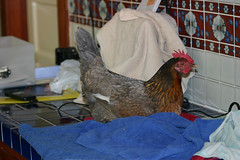
What does Miss Chicken know about impending doom?
In the morning she is happy to see me and chortles with delight as I take her from her cage to the tool shed where I keep her corn. I take a handful and sprinkle it on the ground at the entrance to the back door. She has a special vocalization that she makes when she has found something very delicious like a worm or spider ... or her morning breakfast. The cats walk carefully around her and she watches them closely, too. Sometimes she likes to take a few mouthfuls of their dry food.
I let her roam the backyard for tiny insects. Slugs, which she grabs with deftness, throws it back into her gullet. Happy chicken. Sometimes I buy meal worms for her as treats. The happy sounds that she makes. If she is across the yard and sees me with one in my hand, she will run with her grey skirts flying to snatch the writhing larvae from my fingers.
Sometimes she gets lonesome and calls for me. She used to have a friend but she died several years ago from a heart attack. Miss Chicken hid in the bushes for days. She makes a different call to me when a hawk comes to check her out. or if stray cats come to hunt for birds. When the hawk alights on the fence she yells 'chuck chuck squawk!' If I come home too late at night and she is not at the backdoor for some reason, I hunt for her in the trees.
One night I could not find her. I looked everywhere with a flashlight. I am sure the neighbors think I am crazy. I went to bed sad knowing the raccoons sneak in my yard to hunt for fish in the pond or.... Then in a terrible squawk, with a deep throated clucking she screamed for help. The dark night made it hard for her to see. I jumped from my bed and ran out the side door to find miss chicken had gotten away once again from the jaws of the raccoons. She sat under the light outside and I picked her up. She was quiet when I put her in her cage.
So from where did this terrible H5N1 come from? I know the people in China do not think about their birds like I do - but perhaps some may. One virus or up to ten of them can cause her to be very sick and she would have less then half a chance to live. I carry her about and give her a kiss on her head, so I, too, could become sick from this disease. Where would it come from?
Doves like to clean up her corn that she does not finish. Could they carry it? At night I hear geese flying could they drop it in my yard somewhere in their excrement? Could the raccoons carry it to my yard? or the squirrels? I am in the pathway of the green parrots - could they bring it to us all?
I bought her for five dollars from a ranch not too far away from my house. I found an ad in the throw away papers. I miss not having a chicken in my backyard. She was an adult bird and sat on other birds eggs she is a brooder. She is and has always been a very personable bird and loves to follow Eddie my gardener about when he digs or trims or sweeps.... When she laid eggs, she is now past that time in her life.... she preferred the kitchen counter. To inspire her, I would put my iPod in the towel next to her. She would pull the iPod by dragging it with her 'chin' under her feathers. She would sit on the iPod until her body was ready to expel her egg.
I don't see myself not caring for this animal. What to do....

Wednesday, October 19, 2005
new secretary

Miss Chicken has found her way to my desk. She finds comfort being close to me ....and the cats.
Monday, October 17, 2005
Meromyza sp
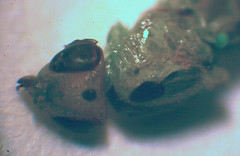
This is a mangled specimen. I have been identifying insects caught on sticky traps for Mugu and the Institute of the Environment and this poor devil was a mess. Also, I have never come across this animal at Mugu on sticky traps nor sweep nets nor Malaise traps. I was stumped!! So, I asked a wonderful entomologist friend to help me out and he said it was in the family of Chloropidae.
Chloropidae. It is one of the very few I have ever seen at Mugu with so very little coloring in its exoskeleton. The haltare was turquoise simply because of the thickness of it tissues. The face was triangular, and it seemed to have a eyespot on its 'forehead.' The femur of its back leg was thick and it had stripes on the dorsal side of its thorax.
One website from Cedarcreek said it was a grass fly that liked to buzz around eyes and wounds. Another said it liked aphids. The three specimens I found on sticky traps were peppered with aphids. In fact, there were more aphids then thirps this season. And, there were more parasitic wasps then from other years.
Could have the storm events of last spring changed the configuration and abundances in the Mugu insects?
Here is a much better picture of this Meromyza sp..
http://cedarcreek.umn.edu/insects/album/029094050ap.html
I have been counting and sorting insect traps and worms from core samples of the soils from Mugu. This is the hard part. Collecting is the easy part. I love collecting and walking and finding new animals.....
Monday, October 03, 2005
Last day at Mugu

My friend and I went to Mugu on Friday, September 30. Beautiful day! But, it was our last day. So very sad. I suppose that the Navy is tired of biologists counting and assessing the plants and animals. Or maybe they are tired of scientists who watch the environment. Or could it be it is not the Navy who does not want us, but those who direct the Navy and other military bases which have the highest number of endangered organisms in the country. Perhaps, with what they do for a living - what they stand for, they hate the idea they must be stewards of important plants and animals.
My friend took this picture of me as I was looking at the different holes in the ground and walking with my net and camera. There were terrible fires in Chatsworth and Ventura the last few days. Ash was falling and drifting all over for many miles. Some of the solitary bees' holes had been usurped by spiders. Maybe, the bees were hiding deep into the ground while the spiders were borrowing the upper chambers because, there were little webs covering the holes festooned with ash.
Sunday, October 02, 2005
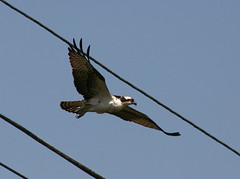
flying-osprey
Sitting on the electrical wire was an osprey which was watching the fish swim in the creek. My friend took this picture as I stepped out of my car.
fall--at-Mugu
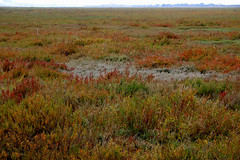
The Salicornia sp. changes colors in the fall. Sometimes with orange-reds sometimes with magentas. This patch of grey-blue is a dead patch caused by a fungus.
Tiger hunting

My friend is a fine hunter of tigers.
The first step in hunting these wonderful animals is to spot them as they stand tall on their long graceful legs like slim twigs on the hot salted soils. Then, you must walk carefully - not letting your shadow cross over them because they will either disappear into the background or fly into the brush. Crouch low with your net out in front and holding the netting with your other hand... in a quiet moment wait for the tiger to clean itself.... then BLAM! Into the net. The tiger struggles in the netting. Its metallic carapace glistens in the sun. It tries to fly and then tries to find an open or torn spot in the net... You wrap the net around the struggling animal. You take the fierce tiger in your finger tips as it gnashes and slashes at you with its sharp mandibles. Such fantastic creatures!
Tuesday, September 27, 2005
Checker White butterfly

This little Checkered White (Pontia protodice), usually found away from urban areas, was flitting about the San Gabriel River in the North Fork. There is a wonderful ephemeral pool where I have found a nice population of California Tree frogs (post September 3) and this one butterfly was very busy. I took this picture just as it was landing. You can see it was unwinding its proboscis in anticipation of the nectar in the flower.
Mountain Sky

At 5:30 on Monday, September 26, the San Gabriels looked as if the ocean of air would boil into a rain storm. You could see deep shapes in the clouds as the tips of the mountains caused the air to flow like water. Below, the wind rippled the water in the reservoir.
After I collected my traps the sky was clear at 6 p.m.
Mayfly

Ephemeroptera, as adults, do not feed but must within hours of emerging, find a mate before they must die. Mayflies are strong indicators of water quality because they need high amounts of oxygen which they take from the water. Animals that breath through the water are more susceptible to heavy metals, and other anthropogenic toxins. Stoneflies, riffle beetles, water pennies, dobsonflies, and caddisflies also are pollution intolerant, and if the body of water is dominated by these animals the water quality is good.
Dragonflies, crane flies, crayfish, dragonflies, clams, crustacea, and beetle larvae can tolerate a much broader range of water quality. However, if the water body has aquatic worms, midge larvae, black fly larvae, pouch snails, leeches and mosquitoes dominating, then the water quality is poor.
This mayfly (and others) were flying above the San Gabriel River at 6 p.m. September 26 the temperature was 81 degrees F. It liked the hood of my car.
Saturday, September 17, 2005
tarantual-hawk
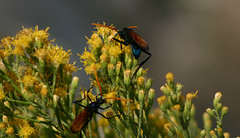
Pompiliidae, Pepsis sp. is one of the largest wasps in the world and has one of the most powerful stings. I kept one in an aquaria for a few months. She was about 4.5 cm long and was as beautiful as these - though, this photo does not do these animals justice.
As adults, they are nectar feeders but as larvae, they consume a still live but paralyzed spider that was provided for them by their mother. They are very expressive animals in that you can tell their temperament by their body language. When excited, they walk jerkily and tap their wings. When calm but excited, they stretch out their antenna. When angry, they point their antenna towards the offending animal and curl and uncurl them. When totally calm the antenna is curled and slightly drooped.
The wasp that I took care of, at first attempted to attack me by flying at my face. In the morning, I would walk into the kitchen and she would pace back and forth with angry movements. I offered her 'cat food juice' and sugar water. I would open the lid very carefully so I could insert a syringe to squirt some sugar water into a small dish. Eventually, she did not display 'anger' when I entered the kitchen, but excitement as in the photograph. Later, she would take the syringe in her front legs and drink from the tip with her antenna curled and drooping.
These animals can never become 'tame' as we might think of some snakes or turtles, but I found my Pepis to be very smart and aware. She knew when I was coming to feed her.
Thursday, September 08, 2005
It's the Holiday ... let's get stupid!!!

It's hot. The River looks beautiful and before you know it everyone takes off clothing and sits around. Then they drink beer, throw the glass bottles around, try to light fires, and move their bowels everywhere, and then leave their trash and yuck behind. What a Holiday!
After

After all of the people left the Mountains on Monday from the long Labor Day Weekend... they left their garbage behind. The Forrest Service men and women end up being housekeepers and trash collectors. Diapers are probably the most disgusting thing - beside the toilet paper all around- I can think of that they throw about. I image these people defecating anywhere from the distribution of their trash. And, just above the river are two port-potties... nasty!
Monday, September 05, 2005
dragonfly
Flame Skimmers (Libellula saturata) have been visiting my pond for many years. Like all dragon flies, in repose. their wings are set to the side. The males are bright red and the females are light red-brown.
I have observed very violent mating rituals in this species. The males will perch on a tall stick waiting - not for what I thought, prey...
Then from above, females spotting the males, dive, grab and essentially rape them. The males are then thrown aside in a daze. While the males buzz erratically about the pond for a moment, the females bounce above the water's surface shooting their now fertilized eggs into the pond water.

I have observed very violent mating rituals in this species. The males will perch on a tall stick waiting - not for what I thought, prey...
Then from above, females spotting the males, dive, grab and essentially rape them. The males are then thrown aside in a daze. While the males buzz erratically about the pond for a moment, the females bounce above the water's surface shooting their now fertilized eggs into the pond water.
Sunday, September 04, 2005
Damsel
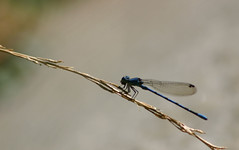
The Vivid Dancer (Argia vivda) is in the Damselfly family, Coenagrionidae. The females are brownish but, on occasion will take on blueish tones. The 'dancers' (genus Argia) hold their wings above their abdomen whereas bluetets (a similar looking damselfly in the genus Coenagrion) hold their wings in repose by their abdomen.
Beautiful-frog
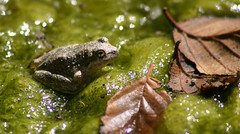
A California Tree frog (Pseudacris cadaverina) sat in an ephemeral pond in the North Fork of the San Gabriel River. The midday sun was about 93 degrees F. and has been quite hot all summer.It is not only a special moment to find this frog sunning itself on top of the angel hair moss, but it is a wonder why this pond still has water in it and it's September 3!
Monday, August 29, 2005
Mugu-upper-marsh
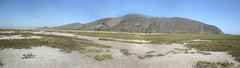
The upper marsh gives one the impression of being alone. The silence is beautiful. The bees quietly buzz 10 centimeters above around the ground. There is so much to learn up here. Water seeps from the hills during the rains and salt water squeezes through the sands from the ocean. I find new animals all the time. Shrews, six types of dragon flies, tiny velvet ants....
Deformed-C-s.f.
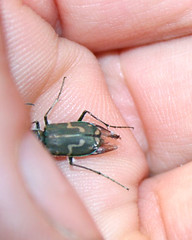
This is the second deformed Cicindela I have found at Mugu. The first one was Cicindela hemorrhagica this one is Cicindela senilis frosti.
Could they have become deformed because of the stress of the storms from last winter? or from water causing objects to deform their pupal cell? or could be it because of some substance in the pore water?
These two beetles were smaller then normal which usually indicates poor nutrition... what could have happened? Could they have had conditions so stressful during their larval stage to force them into complete metamorphosis before proper development?
The numbers of deformed wild insects are usually much smaller then the commercially grown insects like meal worms or crickets. I am surprised to find living tigers with such deformities! They were so easy for me to catch them... a bird would have had them for a small snack.
Pelis-at-Mugu
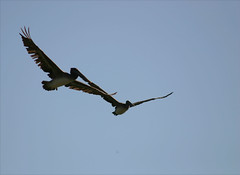
Brown pelicans float on the wind above the water looking for tasty bits just near the surface of the water.
When they see something... they fold their wings, face downward, and dive.
Gosh! To be able to do that!
Otitidea-in-tiger-burrows
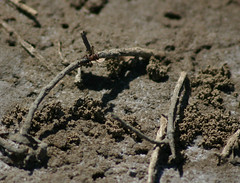
Dancing about the upper marsh is a fly - an Otitidae fly that lays its eggs in the burrows... Whose burrows? Well, there are Halicitidae bees and Cicindela beetles....
It struts and flips its wings, it scurries sideways and drops out of sight into a hole of .... which insect? perhaps both????
Can you find the fly with the pointed face?
Subscribe to:
Posts (Atom)