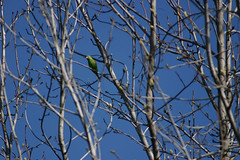
... so, two days ago I was writing about my spider study at Mugu when I thought I heard a parrot 'gacking' outside my window. In Pasadena parrots fly in flocks east and west a couple of times a day. Some times I find a few flocks in trees near Old town Pasadena. And, I have heard that some flocks find the fruit of kaypoc trees
delicious...
I have had some sort of animal eat large holes in my oranges last year, and my pomegranates this year.... I thought it might be rats or birds like the blue jays.... but perhaps not. A flock of parrots flew by on Monday and then I heard a lone parrot next door.
The mocking birds were not too happy. You see, they "own" the tea tree"
and will follow me about as close as five feet away. When the parrot decided that the tea tree was a nice place to sit they chased it up into the liquidamber.
Well, it squaked and carried on until I hung my head outside (it was 92 degrees one Monday!!!!). "Yack!"I yelled, and then it listened. Back and forth I would make some horrible noise and the bird would return a scream. My neighbors already think I am nuts so I have no qualms about hanging out my window and acting like a fool.
Well, it is much cooler today and tonight, so, tomorrow I will put some seeds on the roof and see if it will come to the window.
It looks like a canary parrot, Brotogeris versicolurus chiriri
I had one that I bought from Sears long ago. I felt particularly alone one day and decided to visit the local pet store. Out in the back, with the potted plants, people were yelling and screaming, "It's over here!" "NO! NO! OUCH!!!" and then "DAM BIRD!" and"Can we kill it?!" Three adults with nets and ladders could not catch this feisty bird. For some reason I liked it. "I called up to them, "I'll take it!"
Well, that rallied the troops and they finally caught it after another half an hour. They were very happy to sell the monster to me at a greatly reduced price. He came home with me and was called, ''L'oiseau"
I found my new friend to like grapes. L'oiseau was not very big for a parrot, he was about 8 inches. I have seen large parrots consume grapes and I found that birds have a special capacity for eating them. The large parrots can eat up to 12 grapes before one of them is dejected out the other end. I found L'oiseau was a four grape parrot; one, two, three, four, five/poop, six/poop, seven/poop.... etc.
L'oiseau lived with me for 8 years. It was an adult when I bought him so I really don't know how old he was when I got him. I had a friend take care of him when I went on trips. He would try to be nice to him and L'oiseau would lure my friend to put his fingers in the cage just a bit too close and, "OUCH! IT'S PARROT POT PIE IF YOU ARE NOT CAREFUL!"
Wednesday, February 15, 2006

Thursday, February 09, 2006
cute-tiger
In the dead of winter, it was 82 degrees F... the sky was a beautiful blue without a cloud in sight. There was a soft off shore breeze perhaps 2-3 knots... if that... just to get the few tigers (who were out today) to fly more then five feet.
Up in the upper marsh of Mugu the pans were fairly slicked down from the rains from a month ago... was it a month? No! Strange weather!... The Halictidae burrows were mostly covered over by a thin crust of salt. This allowed the few tigers that were adults to come out to play. A few ladybird beetles flew here and there.
The Lycosidae snuck out from the safety of the Salicornia sp. and Frankenia sp. on the pannes and tried to blend with the back ground - they stood over cracks in the soil - to hide from the Pompilidae who were out hunting for fat spiders for their rookeries. My large (body 2 cm, legs 1.5 cm each) female, caught in September, lets me pet her legs - softly with a toothpick (their bite can become necrotic) and has not taken much food lately. She may be ready to mate.... in which case her wolf spider brothers and sisters in Mugu are in the same condition. A scary time for these creatures - ready do mating displays but, also a special time for the spider wasps, too.
The sun is very important to animals that cannot create the warmth they need for high energy tasks like foraging for food, hunting, mating, running from danger. Tigers bask in the sun so that they can become the fierce hunters we know and love. It is also a way to be able to escape their predators... like me or birds or spiders. Warming in the sun may also play a part in how well they out maneuver the fast flies that they eat, and may determine their rank the inter and intra species hierarchy, too.
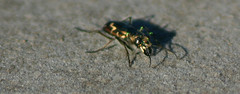
The salt pannes are warm in the sun and the tigers find this very enjoyable. I found this Cicindela senilis frosti basking, turning this side and then the other side to the sun... then again turning its backside to the sun... a full rotation.
Most C. s. frosti caught and pinned in the Los Angeles Natural History Museum and the Santa Barbara Museum are grey with off white markings. The C. s. frosti that I have caught at Mugu come in grey, green, blue, and reddish colors. this one has it all. green, red here and there, and grey. Beautiful.
Up in the upper marsh of Mugu the pans were fairly slicked down from the rains from a month ago... was it a month? No! Strange weather!... The Halictidae burrows were mostly covered over by a thin crust of salt. This allowed the few tigers that were adults to come out to play. A few ladybird beetles flew here and there.
The Lycosidae snuck out from the safety of the Salicornia sp. and Frankenia sp. on the pannes and tried to blend with the back ground - they stood over cracks in the soil - to hide from the Pompilidae who were out hunting for fat spiders for their rookeries. My large (body 2 cm, legs 1.5 cm each) female, caught in September, lets me pet her legs - softly with a toothpick (their bite can become necrotic) and has not taken much food lately. She may be ready to mate.... in which case her wolf spider brothers and sisters in Mugu are in the same condition. A scary time for these creatures - ready do mating displays but, also a special time for the spider wasps, too.
The sun is very important to animals that cannot create the warmth they need for high energy tasks like foraging for food, hunting, mating, running from danger. Tigers bask in the sun so that they can become the fierce hunters we know and love. It is also a way to be able to escape their predators... like me or birds or spiders. Warming in the sun may also play a part in how well they out maneuver the fast flies that they eat, and may determine their rank the inter and intra species hierarchy, too.
The salt pannes are warm in the sun and the tigers find this very enjoyable. I found this Cicindela senilis frosti basking, turning this side and then the other side to the sun... then again turning its backside to the sun... a full rotation.
Most C. s. frosti caught and pinned in the Los Angeles Natural History Museum and the Santa Barbara Museum are grey with off white markings. The C. s. frosti that I have caught at Mugu come in grey, green, blue, and reddish colors. this one has it all. green, red here and there, and grey. Beautiful.
Monday, February 06, 2006
Frosti-2
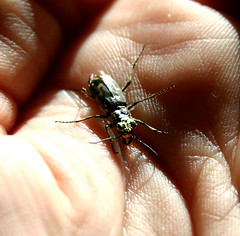
Here is the C.s.frosti that I caught at Mugu in August of last year. He was never a great hunter and with his flight wings mangled, he would never have survived. I feed him tiny crickets, flies, and occasional meal worm and cat food. He digs in the sand when it is cold and runs about when warm. He has a few hypopyl mites, one on his left eye.
Monday, January 30, 2006
too-much-water
Originally uploaded by tardigrade.
California seems to be the land of Paradise to so many. Enough to make the streets and the highways hard to transverse even to go to a market .... and many things must be purchased in shopping malls which very quickly become like a backed-up sewer pipe. This is only one problem of 'Paradise' the other problem is getting things like water to so many people in a naturally dry environment.
Los Angeles was really several towns that grew together via the rails. There was a town at the beach, Santa Monica (still there), which was connected to a light rail which ran down San Vincenty and Santa Monica Boulevard from Downtown Los Angeles. Downtown was THE metropolis and was connected by rail to the Harbor, south, and then, east, out to the city of San Bernardino (my grandfather and his mother moved our here when his father died in Arizona - the town used to be called by the LA locals, "San Berdoo."). The cost of living got out of hand for the everyday citizens, and the City Fathers of LA needed more tax money (at that time the corruption issue in LA was blatant and outrageous) and so people began the ubiquitous suburbs that now choke the entire area.
The movie industry came here because we were so lawless (and immoral .... think about that as you watch the television today). And, just as WWII wound down, and not to ignore some other issues (see the movie Chinatown or watch my documentary - click on it to the right, it's free) folks from various backgrounds (many were either poor farmers or inmates from other state prisons) build the San Fernando Valley.
One has to understand that the San Fernando Valley, historically, was a swamp in some areas, and so today when it rains, the freeway fills with water. Before the homes were build (and all the good workers were taken back from hence they came - I met someone whose father was on one of the teams from jail in Utah) the area was farmland. My grandmother came to LA as a small child by railroad, to be with her grandmother who lived in the Adams District. My grandmother said she could smell the orange blossoms miles before she could see them by train. Fact is, Los Angeles and the surrounding counties have been giving up farming land to houses and such... even as I write this. But, one problem remains - water.
During the early fifties, the AAA and GM got together to get Los Angeles to give up their light rails for freeways and cars (their campaign was to get rid of the ugly electric wires for the clean electric cars that transversed the city so we could see the blue sky - but by 1960 smog eliminated that!!!). GM also invested in land in the Santa Monica Mountains and other areas to create more developments that needed more cars and freeways to get anywhere. And the three sources of water for all of Southern California; Owen's Valley, Sacramento River and the Colorado River, are all coming to their own 'tipping point' with the increases of the human population, climate change, and the need to pour concrete over everything.
There are many little details that go into this story, but I had to give a taste of things because as I drove through yet another area (Agora Hills in Ventura County, one of the fastest growing counties in the basin) that is being torn up for mini-mansions and such. I find stuff like this and I just can't believe it.
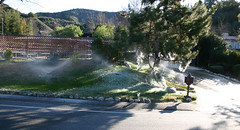
These people have just invested in a multi-million dollar home with automatic this and that... and yet no one is home ....in ALL of the possible definitions. It was chilly the last few nights, and the area can go below freezing, but these people have to have a perfect lawn. Icicles a foot long formed on the trees and the grass and the street and the sidewalk - !!!! everything where the sprinklers poured water, there was ice....!!!! sign.... And what didn't soak the lawn, or froze on the plants and cement, melted in the morning sun and ran down the drain out to the ocean.... only to be seen again in a few years, perhaps.... if we get enough rain.... or snow in the Sierra Nevada's a few hundred miles from here... or the Grand Canyon a thousand miles from here...
California seems to be the land of Paradise to so many. Enough to make the streets and the highways hard to transverse even to go to a market .... and many things must be purchased in shopping malls which very quickly become like a backed-up sewer pipe. This is only one problem of 'Paradise' the other problem is getting things like water to so many people in a naturally dry environment.
Los Angeles was really several towns that grew together via the rails. There was a town at the beach, Santa Monica (still there), which was connected to a light rail which ran down San Vincenty and Santa Monica Boulevard from Downtown Los Angeles. Downtown was THE metropolis and was connected by rail to the Harbor, south, and then, east, out to the city of San Bernardino (my grandfather and his mother moved our here when his father died in Arizona - the town used to be called by the LA locals, "San Berdoo."). The cost of living got out of hand for the everyday citizens, and the City Fathers of LA needed more tax money (at that time the corruption issue in LA was blatant and outrageous) and so people began the ubiquitous suburbs that now choke the entire area.
The movie industry came here because we were so lawless (and immoral .... think about that as you watch the television today). And, just as WWII wound down, and not to ignore some other issues (see the movie Chinatown or watch my documentary - click on it to the right, it's free) folks from various backgrounds (many were either poor farmers or inmates from other state prisons) build the San Fernando Valley.
One has to understand that the San Fernando Valley, historically, was a swamp in some areas, and so today when it rains, the freeway fills with water. Before the homes were build (and all the good workers were taken back from hence they came - I met someone whose father was on one of the teams from jail in Utah) the area was farmland. My grandmother came to LA as a small child by railroad, to be with her grandmother who lived in the Adams District. My grandmother said she could smell the orange blossoms miles before she could see them by train. Fact is, Los Angeles and the surrounding counties have been giving up farming land to houses and such... even as I write this. But, one problem remains - water.
During the early fifties, the AAA and GM got together to get Los Angeles to give up their light rails for freeways and cars (their campaign was to get rid of the ugly electric wires for the clean electric cars that transversed the city so we could see the blue sky - but by 1960 smog eliminated that!!!). GM also invested in land in the Santa Monica Mountains and other areas to create more developments that needed more cars and freeways to get anywhere. And the three sources of water for all of Southern California; Owen's Valley, Sacramento River and the Colorado River, are all coming to their own 'tipping point' with the increases of the human population, climate change, and the need to pour concrete over everything.
There are many little details that go into this story, but I had to give a taste of things because as I drove through yet another area (Agora Hills in Ventura County, one of the fastest growing counties in the basin) that is being torn up for mini-mansions and such. I find stuff like this and I just can't believe it.
These people have just invested in a multi-million dollar home with automatic this and that... and yet no one is home ....in ALL of the possible definitions. It was chilly the last few nights, and the area can go below freezing, but these people have to have a perfect lawn. Icicles a foot long formed on the trees and the grass and the street and the sidewalk - !!!! everything where the sprinklers poured water, there was ice....!!!! sign.... And what didn't soak the lawn, or froze on the plants and cement, melted in the morning sun and ran down the drain out to the ocean.... only to be seen again in a few years, perhaps.... if we get enough rain.... or snow in the Sierra Nevada's a few hundred miles from here... or the Grand Canyon a thousand miles from here...
Sunday, January 22, 2006
stream-monitor
Testing the water in streams, rivers, lakes, and other water bodies has become quite an effort. Runoff, trash, illegal dumping point source pollution from industry damage our drinking water.
What these UCLA students are setting up is a prototype mechanized water tester.... It tests pH, DO, Nitrogen and Phosphorous. It also is a spectrophotometer that can identify the absorbence of the major components in the water.... identifying the algae populations by their chlorophyl.
Can you imagine automated water testers throughout California making sure the water is up to standard and the information broadcast to a main station somewhere....? sort of like wiretapping water before you tap the tapable tap.
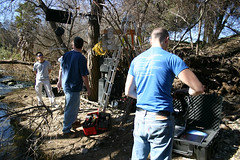
What these UCLA students are setting up is a prototype mechanized water tester.... It tests pH, DO, Nitrogen and Phosphorous. It also is a spectrophotometer that can identify the absorbence of the major components in the water.... identifying the algae populations by their chlorophyl.
Can you imagine automated water testers throughout California making sure the water is up to standard and the information broadcast to a main station somewhere....? sort of like wiretapping water before you tap the tapable tap.
dirty-stream
It is amazing how many water ways in California are filled with trash and peoples' clothes. This particular stream in Ventura County is no exception. Last spring after the water receded from one of our most recent big storms, the up-rooted trees were filled with the branches of downed trees and festooned with trash, underwear, and t-shirts. Why?
Even after months past the big storm, this stream had been found to have a very high intestinal bacteria count. The main source of water of the stream was actually from a water treatment plant which must meet Federal Standards of water quality including low bacterial counts. So, why is this stream in such a bad way?
Well, If the underwear is any indication we may have an answer. Many water courses in Southern California have homeless people living along the banks. The intestinal bacteria... even though the upstream plant is releasing properly treated effluent, may come from the people who find shelter along the water courses.
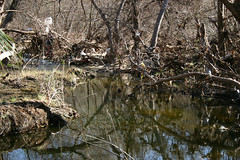
Even after months past the big storm, this stream had been found to have a very high intestinal bacteria count. The main source of water of the stream was actually from a water treatment plant which must meet Federal Standards of water quality including low bacterial counts. So, why is this stream in such a bad way?
Well, If the underwear is any indication we may have an answer. Many water courses in Southern California have homeless people living along the banks. The intestinal bacteria... even though the upstream plant is releasing properly treated effluent, may come from the people who find shelter along the water courses.
chaoborus
Phantom midges, as adults, have only one thing in mind when they emerge from their sleep as a pupae. They don't eat.
They are, many times, the tiny guys that fly around in small swarms above the ground above bushes, or a pond, or a pool, or someone's head. Why or why do they find the hood of my car to be the place for their love nests?
The fly on the left is the male. He has the fluffy antennae.
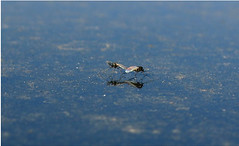
They are, many times, the tiny guys that fly around in small swarms above the ground above bushes, or a pond, or a pool, or someone's head. Why or why do they find the hood of my car to be the place for their love nests?
The fly on the left is the male. He has the fluffy antennae.
Thursday, January 12, 2006
dead-dove
Sweet innocent Ms. Chicken... recently has been hiding under a bush in the backyard. She holds perfectly still and makes a strange soft whirring sound. This usually signals to me that there is somehing scary in the vacinity....
A Sharp Shinned hawk (Accipiter striatus ) has been to the feeders in the past, taking a few doves and I saw it yesterday in a tree above Ms. Chicken's favorite bush. Ms. Chicken is very smart about these things. She barely blinks an eye and I wonder if the hawk notices her being so still, or perhaps hopes that Ms. Chicken will move out of hiding. The hawk's visual system is so keen I can't imagine her not seeing Ms. Chicken.
This afternoon, one of my neighbors had feathers strewn all over the front yard. I had just left the house and did not say good-bye to Ms. Chicken. I was struck by the obvious evidence of a kill and I had to make sure it wasn't anybody I knew.... Towering above the neighbor's house is a huge four story Deodar Cedar (Cedrus deodara) and just about 5 meters up there were white feathers on a branch. Apparently, the hawk captured a white dove and feasted on it earlier in the day. I was relieved.
Sharp Shinned hawks, after killing their prey (birds), carefully pluck out the feathers. Cats, on the other hand, dive right in, bite the head, and tear open the body cavity... so do dogs. Cats and dogs (coyotes) eat the birds from the inside out leaving an over coat (and smaller chunks) with feathers.... Sharp Shinned hawks like to tear off beak sized pieces of a fully plucked prey.The hawks also like to take their prey to some place where no one will disturb them... like cats... dogs eat on the run (like us) so, the branch full of feathers was typical. Now, did the hawk leave anything behind like the beak or claws ...?
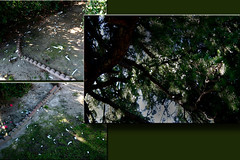
A Sharp Shinned hawk (Accipiter striatus ) has been to the feeders in the past, taking a few doves and I saw it yesterday in a tree above Ms. Chicken's favorite bush. Ms. Chicken is very smart about these things. She barely blinks an eye and I wonder if the hawk notices her being so still, or perhaps hopes that Ms. Chicken will move out of hiding. The hawk's visual system is so keen I can't imagine her not seeing Ms. Chicken.
This afternoon, one of my neighbors had feathers strewn all over the front yard. I had just left the house and did not say good-bye to Ms. Chicken. I was struck by the obvious evidence of a kill and I had to make sure it wasn't anybody I knew.... Towering above the neighbor's house is a huge four story Deodar Cedar (Cedrus deodara) and just about 5 meters up there were white feathers on a branch. Apparently, the hawk captured a white dove and feasted on it earlier in the day. I was relieved.
Sharp Shinned hawks, after killing their prey (birds), carefully pluck out the feathers. Cats, on the other hand, dive right in, bite the head, and tear open the body cavity... so do dogs. Cats and dogs (coyotes) eat the birds from the inside out leaving an over coat (and smaller chunks) with feathers.... Sharp Shinned hawks like to tear off beak sized pieces of a fully plucked prey.The hawks also like to take their prey to some place where no one will disturb them... like cats... dogs eat on the run (like us) so, the branch full of feathers was typical. Now, did the hawk leave anything behind like the beak or claws ...?
Monday, January 02, 2006
Pas-Power
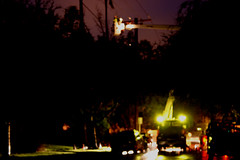
It is cold and rainy. I am not sure how folks can sit out in the rain to watch the Rose Parade every year - but they do. This is the first year in 51 years that it has rained on the parade. It didn't just sprinkle, it poured. And after the parade - every year - the City people from the Water and Power folks to the Trash collectors to the Sewer Maintenance all have to pick up, tear down, re-wire, fix, you name it because of the influx of a few more million people in this small town. The trash is particularly disgusting.
At 3:30 p.m. we had a small electrical outage in my neighborhood. Damn! I was working on something on the computer and while fixing a cup of green tea (and to do some thinking) BLIP! So, I rebooted my Mac....
Then again, at 4 p.m. the power went out on the entire street again. The sky was so dark it could have been night. The rain was getting monotonous. I could see there were flashing lights up the street near the main pole. I decided I could go to some store or another (but wasn't interested), sit in the dark, try to read by candle and flashlight, or go out and watch the guys fix the power. I chose mixing with the power folks.
Fred, the cat, seems to have a penchant for tripping me while I walk to the back door... and in the dark he's got his technique for maximum effect. When I was a kid I used to walk around in my dark room to see if I could remember where things were and could get around as if I were blind. My mother never understood why I like to bumble about in a dark room.... I suspect it must have seemed peculiar. I never ran into things - much. However, the practice in my ill spent youth allowed me to find, in a dark closet with lights, my tripod and my camera and I was able to attach the two together. Fred stayed inside while I went to schmooz with Pasadena Water and Power Maintenance Crew.
There were five trucks two of which had 'buckets' one of which was headed for the top of the electrical post. The heavy winds and rains caused the tall palm trees to drop their heavy palm fronds, The fronds have huge serrated stems and one was straddling all four wires. There was a pile of them just at the bottom of the pole.
Several of the guys were actively watching the workers in the bucket and so I thought I would ask a few questions about the procedure for fixing the downed line. They were happy to talk about what they were doing. One of the guys n the bucket took a pole and shoved the frond off the wire and the wires arched.
Then I asked if Pasadena's power plant at the end of the Pasadena Freeway produced enough power for the whole city. One of the guys seemed very interested in describing how our City gets power. Apparently, our fair City helped another or more... fair cities build their large power plants in Oregon, Utah, Nevada,... gosh, I wonder where else?... so we can buy power from them. The Old Pasadena Power Plant was just too small to produce power for the numbers of new households in the city. As I listened I wondered if and when those other Cities would get too big for their britches... and where would we ALL get our power from?
Like a pyramid game, there comes a time when we can't get any bigger. In fact bigger is not better. Growth becomes a reallllllly bad thing. Sustainability, or worse, stasis will be the word of the day.... Now, that many of us are starting to contemplate a time when oil will not flow like water, and cities will have to be self supporting. Suburbia and all that goes with it will be the monstrosity it really is. Individuals owning cars filling up every open space on the surface of ground will be ridiculous.... and all of this could come rather suddenly... Roger Rabbit will fold his arms and say "THee, I told you so!"
Monday, December 26, 2005
Sediment-in-reservoir
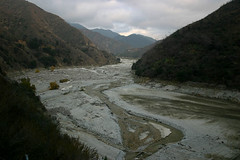
It was my birthday today so, I visited the mountains with a friend. What better way to cheer on another year.
The last couple of days the mornings were cool with some fog and then the sun, in early afternoon, would peak out and warm things up. Two days ago it was 87 Fº in Pasadena - nice. I have been planning to go visit the upper watershed and hoped it would stay warm, but alas, the winter clouds won. Still all in all it was lovely.
Water was still pouring in the East tributary of the San Gabriel River. Most of the small waterfalls off the sides of the mountains have been spent. All summer Public Works have been hauling the sediment from the bottom of the reservoir to another location in the mountains to make room for water in the reservoir behind the dam for next year's winter's rains - and to supply water for drought impacted Los Angeles County.
Dams are funny things. We build them to save water and yet they have a limited 'life' span or usefulness. Rivers are a bodies of water which flow from high places to a lower places - they have a much larger body of water beneath the surface in the soils flowing generally in the same direction, albeit slower.The trees and rocks and animals are swept up in the water, too. The flotsam and jetsam that flow on the surface bring minerals to the iron starved oceans and the sediments enrich the effluvial fans surrounding the rivers. The process distributes the plants, animals and water to the surrounding lands, eroding the mountains away. Before people, the washed out trees, brush, and sediments provided protection from predation, material for breeding, and food in the form of islands for the various ocean going organisms.
We build dams. Then rains and snow-melt, which soak through the soils in the mountains, fill the rivers with water. The force of the water washes sediment down the mountain. The sediment fills up the reservoirs behind the dams, which lowers the depth of the man-made lakes. Depending on the amount of rain, and the decomposition of the mountains' soil and rocks, the man-made lakes can, with some bad luck, be filled and useless in ten to twenty years.
I need to visit the new mountain Public Works created from this summer's dredging of sediment....
hanging-cloud
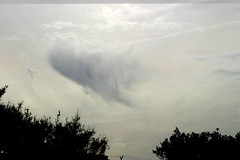
Last Thursday before Christmas the sky was full of these strange clouds. It looked like the clouds wanted to have rain - if you can HAVE rain - but something kept happening to the water droppets. The drops would fall and then get sweeped up back into the air. These silly vapor bags were hanging all over the central vlley of the Los Angeles basin. They somewhat reminded me of a sow's teats.
Sunday, December 18, 2005
Dark-eyed-Junco
Originally uploaded by tardigrade.
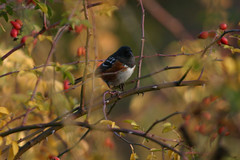
Down under in the bushes and roses, this small bird was turning up the leaves on the floor looking for little yummy bits to eat. Perhaps, a ground beetle, or a earwig, or a snail, or a centipede hiding under a twig in the moist soil. All I could hear was the shushing of the leaves below.
Birds are funny little animals. They are curious, and if you make the right noise they will stop what they are doing and come out from hiding to look at where the noise is coming from. Two sparrows were just above the Junko and my walking closer made them fly away. "Chi-Chi! Chi -Chi!" I said and up came this little bird to look.
Down under in the bushes and roses, this small bird was turning up the leaves on the floor looking for little yummy bits to eat. Perhaps, a ground beetle, or a earwig, or a snail, or a centipede hiding under a twig in the moist soil. All I could hear was the shushing of the leaves below.
Birds are funny little animals. They are curious, and if you make the right noise they will stop what they are doing and come out from hiding to look at where the noise is coming from. Two sparrows were just above the Junko and my walking closer made them fly away. "Chi-Chi! Chi -Chi!" I said and up came this little bird to look.
Ginko-leaves
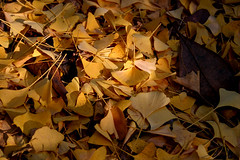
Ginkos, a friend once said, never learned how to be trees - they were too ancient. They grew branches and stems like the lobes on Equisetum, also an ancient plant prior to the Cretaceous Period, sticking straight out perpendicular to the trunk. Oh, but the leaves are so unique and so yellow in fall and early winter here. In China, I have heard people eat the fruit.
Oh , the fruit! They drop to the ground in fall and when crushed, smell like a mixture of dog poo and cheese. However, it is said that they offer good medicine in the form of a vaso-dialator used to help those who forget stuff... Some formulations suggest only using the leaves. Even the yellow jackets that buzz in fall, stay away from the smelly things.... I use them as a deterrent to stepping on my plant beds next to the street. First time steppers in fall are reminded that something was rotten where they last parked...
I'm-so-pretty-oh-so-pretty
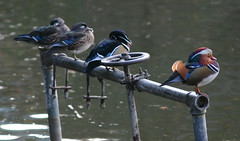
Aix gatericulata, Mandarin Duck
Back at Desconso Gardens... the camellias are revving up this winter and many are open. Some are loosing their petals. All are beautiful and delicate..
How is it that SOME males, like this duck, know how pretty they are and need just that special position to show off? Perhaps prance a bit. Bat its eyelashes. Maybe, take a deep sigh just to show how the rest of the world doesn't come up to its standards....
The male Aix sponsa, Wood Duck, isn't someone to sneeze at. He's beautiful. He's willing to sit next to the Mallards.... Anas sp..
Back at Desconso Gardens... the camellias are revving up this winter and many are open. Some are loosing their petals. All are beautiful and delicate..
How is it that SOME males, like this duck, know how pretty they are and need just that special position to show off? Perhaps prance a bit. Bat its eyelashes. Maybe, take a deep sigh just to show how the rest of the world doesn't come up to its standards....
The male Aix sponsa, Wood Duck, isn't someone to sneeze at. He's beautiful. He's willing to sit next to the Mallards.... Anas sp..
Friday, December 02, 2005
green-road
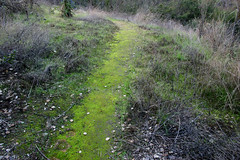
Cicindela no longer run in the San Gabriel Mountains. There are streams and ephemerals that flow all summer long and would be perfect for tigers. When and why they disappeared is not known. Perhaps corralling the streams and rivers into a single flow into a reservoir and the aquifer for the valley below, destroyed their habitats. We will never know.
mysterious-oaks
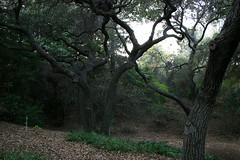
In a forest of California scrub oaks on a rainy grey day, the dark craggy branches remind me of monster movies with Bella Lagosi or Vincent Price.... Perhaps, Roger Corman comes to mind...? My grandfather worked with Roger and Vincent and Bella ... and even let Ed Wood use his studio on Yucca to do some of his ... eh hem, films. Ed Wood scared my mother (who was a kid) when, for a lark, he took his teeth out to prove his disability from World War II. Peter Lori used to visit at my grandparent's home and was apparently quite a funny man despite his dower appearance. Vincent Price was an art collector and loved my grandfather's work. It is too bad I wasn't there to enjoy the ghoulish crowd.
Tuesday, November 22, 2005
so-red

How can it be? It's winter! Damn! I miss the smell of flowers and the buzz of the bugs.
Birds still visit my yard - mostly sparrows and finches. I tried to entice a scrub jay to come down from his tree with a carrot - but he thought I was nuts.... "What do you mean a carrot. I want a peanut!"
California has seasons just not as dramatic as having snow. In the San Gabriel Valley you can watch snow come and go with the rain... it rains down here and the snow drapes on the mountain. I love and miss the flowers...
The Gingko tree is bright yellow and that's wonderful. I sweep the leaves and sprinkle them about the front of my yard between the bushes. The contrasting yellow on the ground is beautiful. I hate throwing away leaves. It is still not cold enough to have killed off the frantic yellow jackets.... they are a nuisance.
The crickets are still singing here and there. I miss them at night in winter. I have some of this wonderful red Delphinium cardinale - a member of the Ranunculaceae family. They are six feet tall and love the dry weather of California. My blue Delphinia continued to bloom until last week...
The best thing about winter are the cool nights..... the short days, the lack of crickets, the few birds, the grey skies.... nah!
Sunday, November 13, 2005
eggs
Ernestine, the leopard tortoise had another batch of eggs...
Ernestine's eggs from last night are on the left. Miss Chicken's are in the middle. And the right two eggs are from the market and they are Large Grade AA.
It is cool outside right now at night. The sun makes the day warm and the tortoises bask. But, last night Ernestine broke through her cage and started digging a hole with her back feet to deposit her eggs.
Ernestine had found a spot of just dirt and she started to dig in it with her long back claws. The soil is dry so she urinated in it to make the soil easy to dig. Ernestine has a huge capacity so the area was as wet as if I had poured a quart of water at her rear.
For three hours she dug and finally she put her head in and pushed hard. Her tail wagged and a clear mucus dripped and then her first egg appeared. It seemed as if this was not only a Herculean effort, but a painful one at that. The egg dropped slowly into the wet soil of the six by 12 inch hole. Each egg was wrapped in this clear mucus that allowed the egg to touch down slowly on the others without a sound. The egg shells are similar to chicken eggs except when the mucus is removed they are more porous.
After the ninth egg she was so tired. She tried to close up the hole but it was around 52 degrees F outside at 10 p.m. and so I decided to bring her inside. I put her in the sink and filled it with warm water. Her eyes were sunken from dehydration and I hoped she would drink as she normally would do. She kept moving her legs as if she was still outside trying to fill the hole with her eggs.
Ernestine does not have a mate and so her eggs are sterile. In the same way as Miss Chicken lays sterile eggs because she, too, does not have a mate. Miss Chicken has several 'times' a year when she is ready to lay eggs. Her personality changes and she does this little dance when I come close to her - I suppose she sees me as her 'mate.' Miss Chicken 'chucks' at the kitchen door to be let in and then finds her spot. She will spend approximately an hour laying her one egg. Ernestine, on the other hand lays many eggs all at once.
Inside Ernestine's egg is very much like Miss Chicken's egg. There is a white and a yolk. Some people like to eat turtle eggs.... like those who like chicken eggs. Sometimes it is hard for me to eat one of Miss Chicken's.... I don't think I can eat Ernestine's..... I will stick to tomatoes and almonds and other plant materials ....
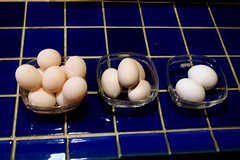
Ernestine's eggs from last night are on the left. Miss Chicken's are in the middle. And the right two eggs are from the market and they are Large Grade AA.
It is cool outside right now at night. The sun makes the day warm and the tortoises bask. But, last night Ernestine broke through her cage and started digging a hole with her back feet to deposit her eggs.
Ernestine had found a spot of just dirt and she started to dig in it with her long back claws. The soil is dry so she urinated in it to make the soil easy to dig. Ernestine has a huge capacity so the area was as wet as if I had poured a quart of water at her rear.
For three hours she dug and finally she put her head in and pushed hard. Her tail wagged and a clear mucus dripped and then her first egg appeared. It seemed as if this was not only a Herculean effort, but a painful one at that. The egg dropped slowly into the wet soil of the six by 12 inch hole. Each egg was wrapped in this clear mucus that allowed the egg to touch down slowly on the others without a sound. The egg shells are similar to chicken eggs except when the mucus is removed they are more porous.
After the ninth egg she was so tired. She tried to close up the hole but it was around 52 degrees F outside at 10 p.m. and so I decided to bring her inside. I put her in the sink and filled it with warm water. Her eyes were sunken from dehydration and I hoped she would drink as she normally would do. She kept moving her legs as if she was still outside trying to fill the hole with her eggs.
Ernestine does not have a mate and so her eggs are sterile. In the same way as Miss Chicken lays sterile eggs because she, too, does not have a mate. Miss Chicken has several 'times' a year when she is ready to lay eggs. Her personality changes and she does this little dance when I come close to her - I suppose she sees me as her 'mate.' Miss Chicken 'chucks' at the kitchen door to be let in and then finds her spot. She will spend approximately an hour laying her one egg. Ernestine, on the other hand lays many eggs all at once.
Inside Ernestine's egg is very much like Miss Chicken's egg. There is a white and a yolk. Some people like to eat turtle eggs.... like those who like chicken eggs. Sometimes it is hard for me to eat one of Miss Chicken's.... I don't think I can eat Ernestine's..... I will stick to tomatoes and almonds and other plant materials ....
Ernestine
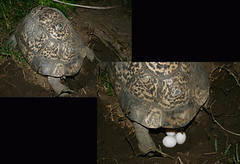
Ah, poor Ernestine. I have looked after her since 1987 when she was the size of a grapefruit. I think that leopard tortoises, Geochelone pardalis, are so beautiful. I bought Ernestine from a pet store whose owner adored tortoises, too. She introduced me to her vet who to this day still comes to look after the menagerie.
Ernestine in action... HERE
Leopard tortoises need to be warm in the sunlight and have access to water - they love to sit in both. When I moved to Ohio these requirements were difficult to adhere to but the house in Ohio had old fashioned radiators under the kitchen sinks. So, I would keep Ernestine in a black plastic cement mixing container on the counter. She also had a light to increase her exposure beyond what we had in the more northern latitude.... and so Ernestine grew.... and grew.
One fateful day, Ernestine now a full 18 inches long and almost 20 pounds, felt she needed to get out of her confinement.
My young daughter and a friend sleep beneath over in the basement in a room for guests beneath the kitchen. In the dark of morning they heard what they thought to be rain falling but, instead they awoke to find the ceiling tiles floating in a foot of water in the basement. They got up in a panic to find water coming down the walls and the stairs ..... Up they rushed to find Ernestine had slipped out of her cement mixing bucket and into the kitchen sink. She had tried to get out of the sink and had turned the hot water on her self. By the time we all saw the deluge, the water was cold... but Ernestine had burned herself quite badly.
The vet in Ohio had me give Ernestine anti-bacterial injections because her neck, her front legs, and her back legs were swollen and smelled of infection. Flies started to infest under her shell but one of the other smaller tortoises kept an eye on the maggots and followed Ernestine about for small snacks. Eventually, Ernestine healed but the scutes on her upper carapace fell off.
How big do leopards tortoises grow? Well, in 1993 I traveled to South Africa, where these reptiles are from. I was standing next to my hosts near an open field near the back brush. Down below in a clearing I spotted something about 3/4 mile away that looked very familiar. I yelled. "it's a tortoise!" and ran down the hill with a small crowd behind me not understanding my glee. I found a small coffee table sized female leopard tortoise which, could have weighed over a hundred pounds.... and out from the bushes around her were four or five males - around 25 to 30 pounds. I brushed her back and found a few ticks the size of the end of my thumb attached to the soft part of her carapace between the scutes. She never flinched as I touched her. Wonderful!
Saturday, November 05, 2005
Ephydridae and Chalcididae

Looking at sticky trap after sticky trap full of so many insects I get very 'antsy'.... sorry.... Funny thing, the 280 8x8 inch sided sticky traps are different from the 280 sticky traps from last year and the year before and the year before that.... What is the difference? Well, this spring had a large storm event that took out a large portion of the Mugu Lagoon habitat. It probably caused changes in the upper watershed that flows into Mugu. There are different genera and families this year. There are many more individuals as well.
Why would something so devastating like the spring 2005 storm event cause so much change? ~ More families, more species more numbers???? Also, there seems to be more parasitoids and hyperparasitoids. This Chalcid wasp (on the right) seems to be stuck on traps in large numbers with even larger numbers of Phoridae.... Are Phoridae parasitized by Chalcids??? (The fly on the left is an Ephydridae a very salt tolerant Diptera)
Sticky traps are like trying to understand ecology in the La Brea Tar Pit style.... When 'A' falls in and gets trapped in the tar pit (sticky trap), it may have been chased by 'B' which, when stuck is attacked and killed by 'C' which is then eaten by 'D'... The difference between digging bones out of the tar pits and identifying insects mushed on sticky traps are different exercises.... oh my aching eyes...
Please note that the larger fly is only 2 mm .... and that there are wasps a quarter the size of this particular Chalcid!!!!
Subscribe to:
Posts (Atom)